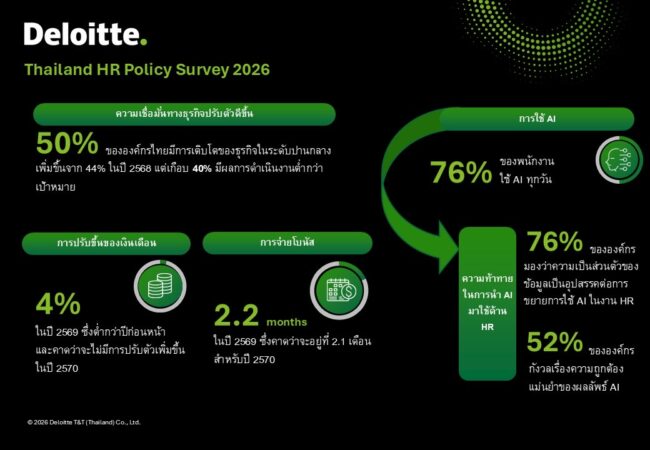
-Salary growth moderates: Median salary increases reached 4% in 2026, with the same rate expected in 2027. Meanwhile, a third of organisations offer premium pay for data analytics and data science skills.
-Business confidence improves, but performance remains uneven: half of surveyed organisations expect moderate business growth, while almost 40% fell below their performance targets.
-AI adoption outpaces organisational readiness: 76% of employees use AI daily, but same percent of organisations cite data privacy as a barrier to broader AI adoption in HR.
BANGKOK, 24 November 2026 — Thai companies are heading into 2027 with growing optimism but face growing challenges in aligning their workforce strategies with changing business needs, according to Deloitte Thailand’s annual HR Policy Survey.
The survey found that the market median salary growth has plateaued 4% in 2026, reduced from 4.5% in 2025, with no acceleration expected in the year ahead. Across sectors, the power, utilities and renewables, as well as the technology, media and telecom sectors recorded the highest salary increase rates of 5%, while the retail, wholesale and distribution sector showed average increase of only a little above 3%, representing the lowest rates among industries.
Actual bonus payments averaged 2.2 months in 2026, with a forecast of 2.1 months for 2027. These trends reflect a more disciplined approach to compensation as organisations balance cost pressures with the need to attract and retain talent.
Business confidence improves, but performance remains uneven
Thailand’s near-term corporate outlook is more optimistic than it was a year ago: half of surveyed organisations (50%) report moderate business growth, up from 44% in 2025, reflecting a broadly improving commercial environment. However, performance remains uneven, with 38% of companies falling below their performance targets, while only 16% exceeded them.
Despite the gap between business confidence and actual performance, workforce reduction expectations remained broadly stable: 60% of organisations expect no reductions, almost the same as last year (61% in 2025).
Mr. Ariya Phukfon, Thailand Technology & Transformation Leader, Deloitte Thailand, said, “Thai organisations are taking a disciplined approach to compensation this year, salary growth has held steady and rewards budgets are being managed carefully as companies balance cost pressures with the need to remain competitive. But compensation discipline alone does not build the workforce a business needs to grow. With growth, cost optimisation, and productivity improvement competing as priorities for businesses, workforce planning needs to be more strategic, instead of simply being a mechanic for managing headcount. The real test for organisations in 2027 is whether their people strategies are keeping pace with their business ambitions.”
According to the results of the survey, the top three priorities shaping the workforce planning are
1) Business growth and expansion, 2) Cost and productivity optimisation, and 3) Organisational and operating model changes. This points to a growing need for organisations to ensure they have the right skills and capabilities to support business priorities.
Skills-based pay gains traction, but formal policies lag
The survey reveals growing recognition of specialised skills in compensation decisions. Data analytics and data science skills command the highest pay premiums, with 31% of organisations offering additional compensation, followed by AI and machine learning skills at 21%.
However, only 15% of organisations have a formal policy for paying premiums for specialised skills, while 39% manage these premiums on a case-by-case basis. As competition for critical talent intensifies, the absence of structured approaches to skills-based pay risks creating inconsistency and inequity that could undermine retention efforts.
AI adoption grows, but workforce planning and governance lag
A similar gap is also seen in the area of AI adoption, where most Thai organisations recognise what is needed but have yet to put formal systems in place for this workforce transformation.
AI is already part of everyday work, with 76% of employees surveyed using AI tools daily. Within the HR function, AI is implemented most in learning and development (44%) and talent acquisition (36%). But strategic workforce planning, the work stream where AI could most directly support long-term business resilience, has been implemented by only 13% of organisations.
The findings also highlight concerns around responsible AI adoption. Organisations (76%) cite data privacy as a barrier to broader AI adoption in HR, while half (52%) are concerned about output accuracy even as AI is already shaping day-to-day HR decisions.
Mr. Gobind Rattivarakorn, Partner, Technology & Transformation – HR Strategy & Technology, Deloitte Thailand, said, “The conversation for Thai organisations is shifting from ‘How do we adopt AI?’ to ‘How do we use AI responsibly and effectively?’ Building trust in AI is central to that question, underpinned by reliable technology, clear accountability, and a commitment to transparency, privacy and fairness. It also requires work being redesigned around human–AI collaboration to deliver real business value. With flattening pay growth alongside rising premiums for AI and digital skills, companies will need to embrace a fundamentally different workforce strategy built around skills and capabilities, not just roles. That is the kind of transformation we work with our clients to design and deliver.”
Deloitte’s annual HR Policy Survey drew on responses from 151 companies across 11 industries, conducted between 10 August and 21 October 2026.